
Friday, August 21, 2026
Stablecoin payments for SaaS companies: a practical guide
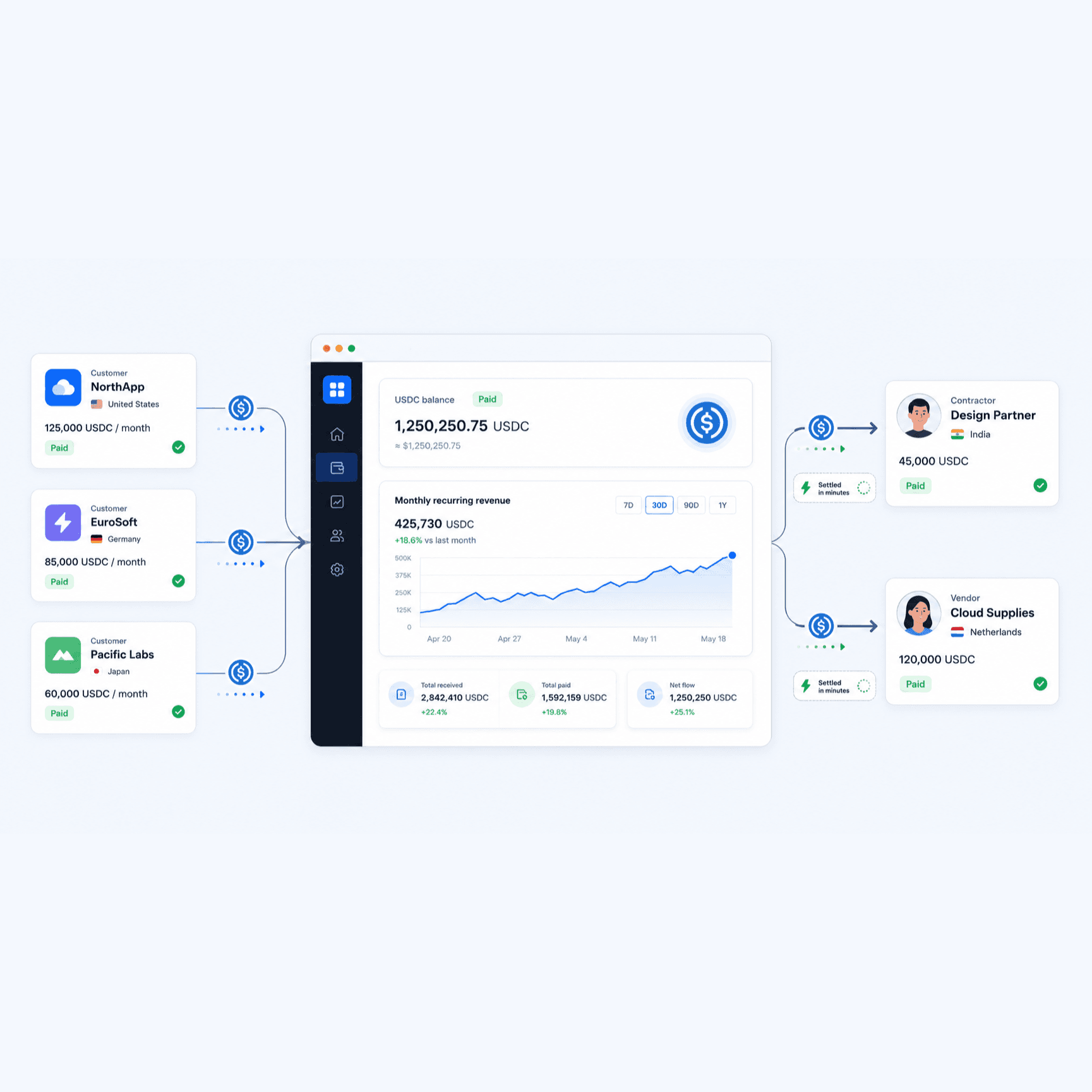
When finance leaders at SaaS companies hear "stablecoin payments," many still picture crypto trading: volatile assets, exchange accounts, and speculation. That mental model blocks good decisions. Stablecoin payments for SaaS are not about trading. They are about moving dollar-pegged value across borders faster and cheaper than wires, using USDC or USDT as the settlement rail.
For a SaaS company, stablecoin payments means using stablecoins to collect revenue from customers, pay contractors and vendors, or both, without treating crypto as a treasury bet. The stablecoin is infrastructure, like SWIFT with better uptime.
This guide is for finance and operations leaders at SaaS companies doing roughly $5M to $100M ARR: big enough to have cross-border contractors, international customers, and real payment volume, but not so large that every decision requires a six-month procurement cycle. If that is you, read on.
What we mean by stablecoin payments
A stablecoin is a digital currency pegged to a fiat currency, most often the US dollar. USDC and USDT hold a $1 value. You are not exposing your business to Bitcoin volatility. You are using a dollar that moves on a blockchain instead of through correspondent banks.
For SaaS companies, stablecoin payments break into three distinct use cases:
1. Collecting revenue. Some customers, especially crypto-native companies or teams in markets with limited dollar access, prefer to pay invoices in USDC. You receive stablecoins and convert to fiat or hold them in your operating account.
2. Paying vendors and contractors. The more common starting point. Your design agency in Portugal, your DevOps contractor in Argentina, your content team in the Philippines: stablecoin payouts settle in minutes at a fraction of wire cost.
3. Treasury management. Holding stablecoin reserves, moving liquidity between entities, or managing multi-currency balances across wallets and bank accounts. This is real, but it is not where most SaaS companies should start.
Ignore treasury at first. Start with payments.
Take a marketing agency client we worked with: $12M ARR, 35 contractors across eight countries, paying through a mix of Wise, PayPal, and manual wires. Their finance lead spent two days each month on payment operations alone. They did not need a crypto treasury strategy. They needed to pay 35 people reliably without losing 3% to fees on every transfer. Stablecoin payouts solved that in the first month.
Why SaaS companies are paying attention now
Global customer bases mean slow collections. SaaS companies sell worldwide, but getting paid from certain markets still takes weeks. Customers in emerging markets may face banking friction paying USD invoices. Offering stablecoin payment options can shorten collection cycles for the segment of your base that prefers it.
Contractor and vendor payroll crosses borders by default. Remote-first SaaS teams rarely hire entirely in one country. Engineering in Eastern Europe, design in Latin America, support in Southeast Asia: the payroll map is global even when revenue is concentrated in the US or EU. Traditional rails charge per corridor and per transfer.
Payment processing fees on enterprise deals add up. Card payments on self-serve plans are one cost line. Enterprise deals are another. A $50,000 annual contract paid by card at 2.9% is $1,450 in processing fees before FX, chargebacks, or payout delays. Stablecoin invoicing for crypto-native enterprise customers removes that layer entirely.
Customers increasingly prefer it. A growing share of B2B buyers, especially in web3, fintech, and global services, hold USDC and expect to pay vendors the same way they pay each other. Offering stablecoin payment options is becoming a commercial requirement, not a novelty.
The practical setup, in brief
Running stablecoin payments at a SaaS company requires four components working together:
1. A [Business Account](https://www.requestfinance.com/products/business-account) that holds fiat and stablecoin balances in one place, with visibility for your finance team.
2. On-ramp and off-ramp access so you can fund the account from your bank and recipients can receive local currency if they choose.
3. A payment operations platform like Request Finance for invoicing, batch payouts, approval workflows, and reconciliation.
4. Accounting integration with QuickBooks or Xero so stablecoin transactions land in your books like any other payment.
For the full technical and compliance picture, see our Complete Guide to Stablecoin B2B Payments in 2026.
On chain selection: default to Base unless you have a specific reason not to. USDC on Base is cheap to transfer, widely supported, and backed by Circle. Most SaaS payment flows do not need Ethereum mainnet fees.
Lessons from companies we have worked with
Three objections come up in every first conversation:
"We are not a crypto company." Neither are most of our customers. They are SaaS, agencies, staffing firms, and marketplaces that happen to pay people in 15 countries. Stablecoins are a payment rail, not a business model.
"Our accountants will not allow it." They will, once the transactions are recorded, reconciled, and auditable the same way as wires. The accounting treatment is business revenue and business expense, not a trading position.
"Our contractors will not accept it." Many already ask for USDC. For those who prefer fiat, the off-ramp delivers local currency to their bank account. You send stablecoins; they receive what they need.
The mistake we see most often is the CEX workaround: using Coinbase, Binance, or Kraken as a business payment tool. Teams share one login, manually send transfers, and hope nobody mistypes an address. That creates four problems:
- Shared logins with no role separation between preparer and approver
- No approval workflows before funds leave the account
- No spending policies or per-transaction limits
- No audit trail that maps cleanly to invoices or payroll lines
A business payment platform exists precisely because consumer exchange accounts were never designed for this.
What companies get wrong
Mistake 1: Trying to replace Stripe
Stripe handles self-serve card payments beautifully. Stablecoin payments do not replace that workflow. They complement it. Keep Stripe for your $99/month plans. Add stablecoin invoicing for enterprise customers who want it, and stablecoin payouts for contractors who need it. Different rails, different use cases.
Mistake 2: Starting with treasury
Finance leaders read about stablecoin treasury management and want to hold USDC reserves, optimize yield, and run multi-wallet strategies before they have paid a single contractor in stablecoins. Start with one payment use case. Prove the workflow. Expand from there.
Mistake 3: Building your own workflow
Engineering teams propose building payout automation on top of Coinbase APIs. Six months later, they have a script that sends USDC but no approval layer, no recipient onboarding, no accounting sync, and no compliance infrastructure. Buy the operational layer. Build your product instead.
Where it works well and where it does not
Banks still win when:
- Payments are domestic within well-banked markets (US ACH, SEPA)
- Enterprise customers require traditional bank invoicing with no flexibility
- Payment volume is too small to justify platform setup
- Your industry mandates bank rails for regulatory reasons
Stablecoins work well when:
- You pay contractors or vendors across multiple countries every month
- FX spreads and wire fees exceed 2% on your cross-border corridors
- Recipients ask for USDC or need faster settlement than 2 to 5 business days
- Crypto-native customers want to pay invoices in stablecoins
The key takeaway: most SaaS companies do not need to choose one rail forever. They need to stop running a fragmented treasury where revenue sits in a bank, contractor payments go through Wise, enterprise collections run on Stripe, and nobody can answer "what is our total cash position?" in one screen. Stablecoin payments are one part of consolidating that picture.
How to start without overcomplicating it
1. Pick one use case. Contractor payments are the most common starting point. Choose the corridor where fees hurt most.
2. Open a Business Account and complete KYB. Verification usually takes a few days. You can explore the platform before going live.
3. Onboard five to ten contractors. Have each register their preferred payout method: USDC wallet or local bank account.
4. Run one full payment cycle. Import the batch, route through approval, execute, and reconcile against your existing payroll records.
5. Measure and expand. Compare settlement time, total fees, and finance team hours against your previous process. If the numbers work, roll out to the rest of the roster.
Summary
Stablecoin payments for SaaS are not about becoming a crypto company. They are about paying global teams and collecting from global customers without losing days and percentage points to infrastructure built for a different era.
If 25% to 30% of your vendor or contractor spend crosses borders, stablecoin payments usually repay the setup cost quickly. Start with 10% of those payouts in a pilot before migrating the full roster. Most teams that run one successful cycle do not go back to manual wires for that corridor.
Frequently asked questions
Do we need to hold crypto on our balance sheet?
No. You can fund your account in fiat and convert at the moment of payment. Stablecoin exposure can last minutes, not months.
Can we still use Stripe for self-serve plans?
Yes. Stablecoin payments complement Stripe; they do not replace it. Use each rail for the use case it handles best.
How do we pay contractors who want local currency?
You send stablecoins from your account. The platform off-ramp delivers pesos, euros, or other local currency to their bank account. See our guide on contractor payments for the full workflow.
What about accounting and audit?
Stablecoin payments are recorded like wire transfers. Request Finance exports to QuickBooks and Xero, with a full audit trail of approvers, amounts, and timestamps.
Is this compliant for a US or EU SaaS company?
Yes, when you use a verified platform with KYB on your entity and proper record-keeping. Stablecoin payouts to contractors are a settlement method between two businesses. Confirm jurisdiction-specific rules with your counsel.
Which stablecoin should we use?
USDC on Base is the default recommendation for most SaaS payment flows: low fees, strong regulatory posture, wide adoption. Let recipients choose USDT if their corridor prefers it.
About Request Finance
Request Finance is a stablecoin-native B2B payments platform that helps companies manage invoicing, contractor payments and payment operations in USDC and other stablecoins, with accounting integrations for QuickBooks and Xero.
The Request Business Account gives each entity dedicated account details and stablecoin wallets, with multi-currency support and real-time visibility. Corporate cards are coming soon.
Free guide
The stablecoins guide for CFOs
A practical resource for finance teams working with stablecoins: accounting, compliance, treasury and payments.