
Wednesday, September 9, 2026
Stablecoin Cross-Border Payments vs. SWIFT & Wire Transfers
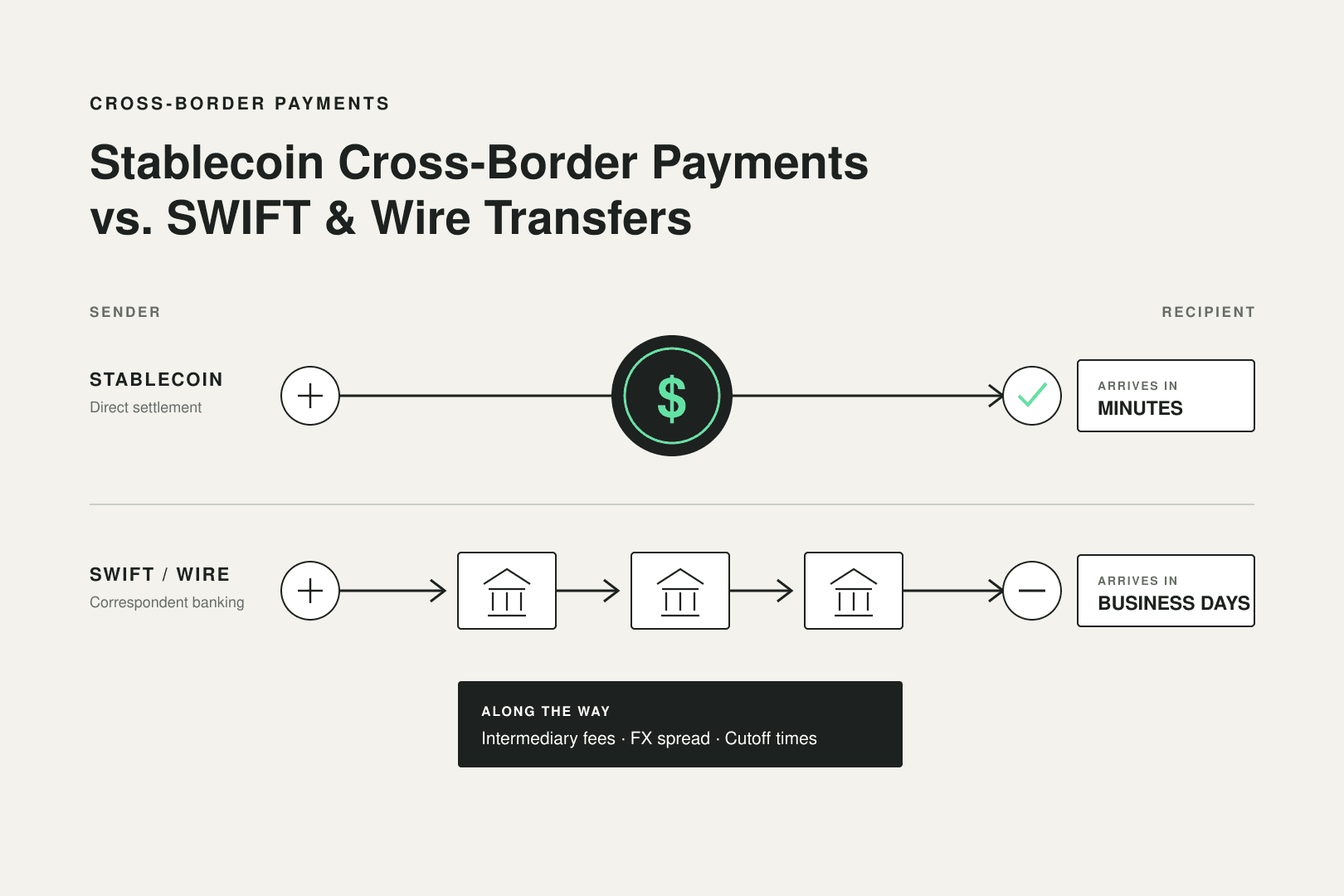
Stablecoin cross-border payments move dollar-pegged digital currencies like USDC directly between wallets instead of routing money through the chain of correspondent banks that SWIFT wires rely on. The practical difference: settlement in seconds to minutes instead of 2-5 business days, and a flat fee of a few cents instead of a stack of sending fees, receiving fees, and an FX spread that together commonly run 3-5% of a typical B2B wire. Higher on average across all remittance corridors, where the World Bank puts the global blended figure at 6.36%.
If you're paying an overseas supplier, a contractor abroad, or moving treasury between entities in different countries, this is the comparison that actually matters: not "crypto vs. banking" in the abstract, but SWIFT and wire transfers vs. stablecoins for the specific job of moving business money across a border.
A marketing agency paying 50 contractors monthly across 12 countries is exactly the kind of case where stablecoin payments solve a real pain point: instead of stacking wire fees and FX spread on every single payout, the agency pays just a small flat fee per transfer, regardless of country or amount.
Why cross-border payments are slow and expensive today
For decades, moving money across borders has meant SWIFT and correspondent banking. It works, but it's slow and it's not cheap. The World Bank Remittance Prices Worldwide tracks this directly: across 367 country corridors, the global average cost of sending money internationally is 6.36% of the amount sent, more than double the G20's own target of 3% by 2027.
Speed has improved. SWIFT gpi network now settles about 60% of payments within 30 minutes and nearly all of them within 24 hours, moving roughly $300 billion a day. That's a real improvement over the multi-day transfers SWIFT was known for a decade ago. But "improved" isn't "fast," and cost hasn't moved nearly as much as speed has.
Stablecoins settle differently: on-chain in seconds to minutes, on networks that don't close for weekends or bank holidays. Total stablecoin supply has grown to around $305 billion, and industry volume is now roughly $30 billion a day, according to McKinsey's 2025 Global Payments Report, still a fraction of what moves through SWIFT, but growing fast, with issuance roughly doubling since early 2024.
The caveat: there's no official body tracking stablecoin payment costs the way the World Bank tracks remittance costs, so a direct percentage-to-percentage comparison doesn't exist yet. What's clear is where the cost actually sits. On-chain, moving a stablecoin costs a network fee; fractions of a cent on some chains, a few dollars on others. The real cost of a stablecoin payment is what it takes to convert in and out of fiat at either end, and that's set by whichever provider handles the on/off-ramp, not by the network itself.
That's also where the practical difference shows up for a business paying international invoices or contractors: SWIFT's cost and delay come from routing a payment through a chain of correspondent banks, each taking a cut and adding time. A stablecoin payment skips that chain; the money moves directly, and the only real friction left is converting to and from local currency at the edges.
Why stablecoin payments are taking off
As FXC Intelligence put it in its State of Stablecoins in Cross-Border Payments report: "For the cross-border payments industry, it's clear that 2025 is the year of stablecoins. New announcements about projects using the technology are being made on an almost daily basis, while landmark regulation is bringing stablecoins deeper into the traditional ends of the market." That shift has only accelerated since.
McKinsey's 2025 Global Payments Report goes further, framing stablecoins outright as 'an always-on alternative to correspondent banking' for settlement, not just a faster payment method, but a structural workaround for the chain of banks a wire has to pass through.
Three things are converging at once.
First, regulatory clarity has arrived in the markets that matter most: the US GENIUS Act, the EU's MiCA (in force since 2024), and frameworks in the UK, Singapore, and Hong Kong have all moved stablecoins from a gray area to a regulated asset class in the last two years, a large part of why FXC Intelligence called 2025 "the year of stablecoins."
Second, the policy pressure on traditional rails is coming from the top down. The G20's own Cross-Border Payments Roadmap, coordinated by the FSB, set a public target of getting average retail cross-border payment costs to 3% or lower by 2027 (FSB Roadmap progress reports). Against a 6.36% global average today, that's regulators effectively admitting the current system isn't fast or cheap enough. Stablecoins already clear that bar, years ahead of the deadline.
Third, volume is already moving, not just sentiment. McKinsey's 2025 Global Payments Report puts stablecoin transaction volume at roughly $30 billion a day industry-wide, with issuance roughly doubling since early 2024. Total stablecoin supply in circulation now sits around $305 billion (RWA.xyz). That's still a fraction of the roughly $300 billion SWIFT moves per day, but the trajectory, and regulators building rails around it instead of against it, is the real story.
How stablecoin cross-border payments work
The mechanics are simpler than the banking version, precisely because there's no correspondent chain:
- Your company holds stablecoins, converted from fiat via an on-ramp, or received directly from a customer.
- Your counterparty has a wallet address, the cross-border equivalent of bank details.
- You send the transfer directly, wallet to wallet, no intermediary bank involved.
- It settles on-chain: typically 1-5 minutes on Ethereum, often under 30 seconds on Layer 2 networks (Base, Polygon, Arbitrum) or Solana.
- The recipient either holds the stablecoin or converts it to local currency through an off-ramp, if they need fiat.
The network fee for that transfer, the blockchain equivalent of a wire fee, is typically a few cents to a couple of dollars, and critically, it doesn't scale with the size of the transfer. A flat network fee of a few cents applies whether you're sending $500 or $10,000. That's structurally different from a wire, where FX spread is a percentage of the amount moved: the bigger the transfer, the more a percentage-based spread costs you in absolute terms.
Stablecoin vs. SWIFT vs. wire transfer: the comparison
Stablecoin vs. SWIFT vs. wire transfer
Cost, speed, and operational differences for cross-border B2B payments
| SWIFT / correspondent bank wire | Stablecoin transfer | |
|---|---|---|
| Sending fee | $25-50 | ~$0.01-0.10 (network fee) |
| Receiving fee | $10-30 (correspondent bank) | None |
| FX spread | 1.5-3% (non-USD) | None: USD-denominated |
| All-in cost | 6.36% global average across all remittance corridors¹ | No official average: cost is effectively the on/off-ramp provider's fee, not the network's |
| Settlement time | 1-5 business days typical (SWIFT's own gpi network clears ~60% of tracked payments within 30 minutes², but only for banks on gpi with no compliance hold) | Under 1 minute on most networks |
| Available hours | Business hours, both jurisdictions | 24/7/365, incl. weekends/holidays |
| Fee scaling | FX spread scales with transfer size | Flat fee regardless of size |
| Traceability | Bank statement, opaque mid-chain | Full on-chain audit trail |
| Reversibility | Recallable within a window | Final on settlement: no chargebacks |
| Public policy target | G20 target: retail cross-border payments ≤3% by 2027³ | No equivalent target exists |
The reversibility row cuts both ways: no chargebacks means no accidental-payment safety net, but it also means no clawback risk for the recipient once a transfer settles. For a supplier who's been burned by a reversed or delayed wire before, that finality is often a selling point, not a drawback.
Real-world scenarios
Paying an overseas supplier. A US design firm sends $300,000 a month to overseas suppliers in Italy, Turkey, Vietnam and Mexico for furniture, lighting, textiles, and tile. If they wire the money on a Thursday afternoon, it has to pass through several correspondent banks, and by the time you add the time difference and Vietnam's banking hours, the funds might not actually land until the following week. The supplier often won't ship until they see the money, so the order just sits there waiting.
With USDC instead, the transfer settles in minutes, the supplier sees it hit their wallet right away, and the shipment goes out immediately, no days-long wait in between.
Paying a contractor abroad. An Australian based tech company pays an AI consultant in Argentina, ~$6,000/month, invoiced twice monthly. Historically, that's a wire that costs $60-90 in combined fees, arrives 2-4 business days later, and lands in pesos at whatever rate the receiving bank applies that day. In a high-inflation environment, it costs the contractor real purchasing power. Paid in USDC, the contractor receives the full $6,000-equivalent in dollar-pegged value within minutes, and can hold it in USDC rather than convert immediately if they'd rather not take the local-currency exposure at all.
Moving treasury between subsidiaries. A multi-entity company needs to move $500,000 from its US parent to a subsidiary in Singapore to fund local payroll. Bank-to-bank, that's a wire with its own fees and a multi-day settlement window, plus internal approval friction because it's treated like any other outbound wire. On-chain, entity-to-entity, it settles in minutes with a complete, timestamped audit trail, which also makes it easier to reconcile for both entities' books.
Risks & limitations
Stablecoins aren't a strictly-better replacement for every cross-border flow. A few real limitations are worth naming plainly:
Off-ramp access varies by geography. Converting stablecoins to local currency is straightforward in some markets and still genuinely difficult in others. Off-ramp infrastructure providers like Yellow Card and Bitso have built out access across parts of Africa, Latin America, and Southeast Asia, but coverage isn't uniform everywhere. In practice, this is less of a blocker than it sounds; many recipients in dollarized or high-inflation economies would rather hold USDC than convert it immediately, which removes the off-ramp question entirely.
Regulatory treatment still varies by country. The US (GENIUS Act), the EU (MiCA, in force since 2024), the UK, Singapore, and Hong Kong all now have clear stablecoin frameworks. But "clear" doesn't mean "identical," and a handful of jurisdictions still lack settled rules. Check local treatment before making this the default rail for a new corridor.
Liquidity and counterparty readiness. Both sides of the transaction need a wallet and, generally, some comfort with the mechanics. This is a smaller barrier every year. Contractors increasingly ask for USDC unprompted, but it's not zero, particularly for large legacy suppliers whose finance departments haven't touched crypto before.
The objection finance teams raise most often is some version of "our contractors won't accept it." In practice, plenty of contractors already ask to be paid in USDC directly. And for the ones who'd still rather have fiat, that's not actually a blocker: an off-ramp converts the stablecoin to their local currency and deposits it straight into their bank account. The business sends stablecoins either way; what the contractor receives is whatever they've asked for.
Finality means no do-overs. A wire sent to the wrong account can sometimes be recalled. A stablecoin transfer, once confirmed on-chain, can't be. Address verification matters more here than it does with a bank transfer.
How to start making cross-border payments in stablecoin
Don't try to convert every corridor at once. The practical path:
- Pick the corridor with the most friction today: usually whichever contractor, supplier, or subsidiary relationship involves the slowest, most expensive wires currently. That's where the savings are most visible fastest.
- Confirm the counterparty can receive it: do they have a wallet, or do they need help getting one? Good stablecoin payment platforms handle this onboarding step.
- Run one transaction end-to-end before scaling: send it, have them confirm receipt (and off-ramp if they choose to), and reconcile it in your books before moving your next five payments the same way.
For the fuller implementation walkthrough, choosing a platform, setting up on/off-ramps, and what your finance team needs in place before the first payment, see our Complete Guide to Stablecoin B2B Payments.
We believe that when stablecoins are trusted, scalable and interoperable, they can fundamentally transform how money moves around the world. Rubail Birwadker, Global Head of Growth Products, Visa
FAQ
How much cheaper is a stablecoin cross-border payment than a SWIFT wire?
For a typical $10,000 B2B cross-border payment, a wire's combined sending fee, receiving fee, and FX spread usually runs $300-500 more than the equivalent stablecoin transfer, which costs a few cents to a couple of dollars in network fees regardless of size. That's a conservative per-transaction estimate; the World Bank's broader global average across all remittance corridors is higher, at 6.36% of the amount sent, which would put an all-in wire cost on $10,000 closer to $636.
How much faster do stablecoin payments settle than wire transfers?
A wire takes 1-5 business days to clear the correspondent banking chain. A stablecoin transfer settles on-chain in 1-5 minutes on Ethereum, often under 30 seconds on faster networks like Base, Polygon, or Solana, and it isn't limited to business hours.
Can I send a stablecoin cross-border payment on weekends or holidays?
Yes. Unlike a wire, which only moves during banking hours in the sending and receiving jurisdictions, a stablecoin transfer settles 24/7, including weekends and bank holidays in either country.
Is it safe to use stablecoins for cross-border business payments?
In most major jurisdictions, yes. USDC and similar stablecoins now operate under regulated frameworks like the US GENIUS Act and the EU's MiCA. The main practical risks are counterparty readiness (does the recipient have a wallet), off-ramp access in some regions, and the fact that on-chain transfers are final once confirmed, unlike a recallable wire.
Do stablecoin cross-border payments work in every country?
Mostly, but not uniformly. Sending is straightforward almost anywhere with internet access. Converting to local currency (off-ramping) is easier in some markets than others, though many recipients in dollarized or high-inflation economies prefer to hold the stablecoin rather than convert it immediately.
What's the best stablecoin for cross-border B2B payments?
USDC and USDT are the two most widely used. USDC is generally the more compliance-forward, fully-reserved, regularly-audited option; USDT has the largest global volume and is more commonly used in markets where dollar access is otherwise constrained.
Ready to move a cross-border payment off wires?
Request Finance helps businesses send stablecoin payments to contractors, suppliers, and subsidiaries in 190+ countries, with built-in on/off-ramps and accounting integration. Book a demo to see it on your own corridor.
Free guide
The stablecoins guide for CFOs
A practical resource for finance teams working with stablecoins: accounting, compliance, treasury and payments.